Aluminum 6061 vs 7075: when to choose each (guide for Mexican machine shops)
Technical comparison 6061-T6 vs 7075-T6 with mechanical properties, relative cost in Mexico, machinability, weldability, corrosion resistance, and industry recommendation. Property table with ASTM B209 / MIL-HDBK-5J sources and national supplier directory.
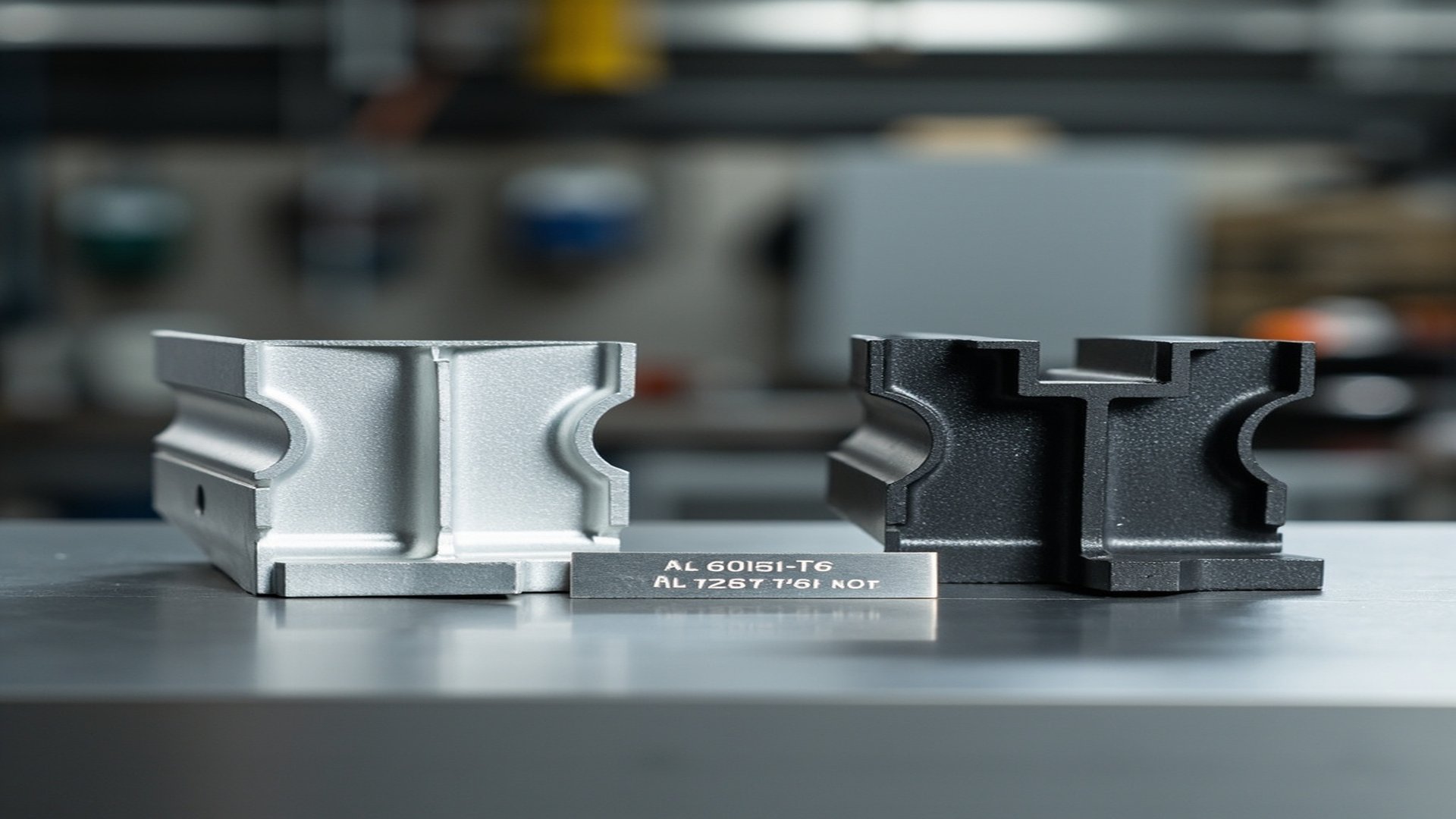
Technical comparison of two aluminum alloys that dominate Mexican machine shop orders: 6061-T6 (workhorse) and 7075-T6 (aerospace-grade high strength). Mechanical properties, cost per kg, machinability, weldability, corrosion behavior, and industry-by-industry use cases.
· ~5 min read
The decision that repeats on every quote
When a print arrives with “aluminum 6061 or equivalent” alongside another marked “7075-T6 per AMS-QQ-A-250/12”, the decision looks technical but is economic. 6061 covers 70–80% of general orders; 7075 enters when strength calculation demands it or the aerospace customer mandates the spec. Choosing wrong means paying 2–4× more for material you don’t need — or losing the customer by using an alloy that doesn’t qualify.
This guide compares both alloys with verifiable datasheet data, relative costs in the Mexican market, and the key question: what is each one actually for in practice?
The properties that matter in the shop
The difference between 6061-T6 and 7075-T6 isn’t a grade difference, it’s an alloy system difference:
- 6061-T6 belongs to the Al-Mg-Si system (6xxx series). Magnesium and silicon form Mg2Si precipitates during T6 heat treatment.
- 7075-T6 belongs to the Al-Zn-Mg-Cu system (7xxx series). Zinc (5.1–6.1%) combined with magnesium and copper creates a much denser precipitate structure — the reason for its superior strength.
The 7xxx system produces nearly double the strength of the 6xxx system, but introduces copper (1.2–2.0%) that reduces corrosion resistance — the fundamental metallurgical trade-off between the two alloys.
Comparative table: mechanical properties
| Property | 6061-T6 | 7075-T6 | Ratio 7075/6061 |
|---|---|---|---|
| Ultimate Tensile Strength (UTS) | 310 MPa | 572 MPa | 1.84× |
| Yield Strength (YS 0.2%) | 276 MPa | 503 MPa | 1.82× |
| Shear strength | 207 MPa | 331 MPa | 1.60× |
| Elongation at break | 12–17% | 8–11% | 0.65× (less ductile) |
| Brinell hardness | 95 HB | 150 HB | 1.58× |
| Density | 2.70 g/cm³ | 2.81 g/cm³ | 1.04× |
| Elastic modulus | 68.9 GPa | 71.7 GPa | 1.04× |
| Thermal conductivity | 167 W/(m·K) | 130 W/(m·K) | 0.78× (lower) |
| SCC resistance (ST direction) | Good | Poor | — |
| Weldability | Excellent | Poor (not recommended) | — |
Sources: ASTM B209, MIL-HDBK-5J [datasheet compiled in Nifty Alloys ‘6061-T6 vs 7075-T6 Aluminium’, jul-2026; BenchChem comparative study, 2024].
When to choose 6061-T6 (5 clear cases)
- Welded structures: 6061 is one of the few aluminum alloys weldable by TIG/MIG without significant loss of properties in the heat-affected zone. 7075 is NOT recommended for welding — it cracks.
- Formed parts: high elongation (12–17%) means 6061 bends, rolls, and deep-draws without fracturing under standard shop conditions.
- Marine or outdoor applications: low copper content makes it resistant to general corrosion and immune to stress corrosion cracking (SCC) in T6 condition.
- Medium-to-high volume production: machinability rating 90 (excellent) means 20–30% faster cutting speeds and lower tool wear than 7075.
- When the customer does not specify alloy: 6061-T6 is the sensible default. It covers 80% of non-critical structural applications at a fraction of the cost.
When to choose 7075-T6 (5 clear cases)
- Structural aerospace components: blades, fuselage sections, landing gear parts. AMS-QQ-A-250/12 specification is mandatory at OEMs like Boeing, Airbus, Lockheed.
- Fatigue-critical parts: fatigue limit 159 MPa vs 95 MPa for 6061. Under cyclic loading, 7075 survives where 6061 fractures.
- Firearm receivers, high-performance bicycle frames, climbing hardware: where failure is not an option and the strength-to-weight ratio is priority.
- Low-production molds and tooling: 150 HB hardness resists wear better than 95 HB of 6061 when the cycle is short.
- When strength calculation demands it: if FEM analysis shows Von Mises stress >200 MPa in a critical zone, 6061 falls short on safety margin.
💰 Real cost: 7075-T6 bar stock costs 2 to 4 times more per kilogram than 6061-T6 in the reference international market, and machining time increases 15–25% due to higher hardness and tool wear. Total finished-part cost in 7075 typically runs 2.4 to 2.8× its 6061 equivalent [Source: Arcus CNC, xcmachining.com 2026].
The anodizing factor nobody accounts for
If the part requires an anodized finish, the decision tilts further toward 6061. The high copper content of 7075 causes three specific problems in anodizing:
- Non-clear dye: copper incorporates into the oxide and produces a gold or brown tint even when class 1 (no color) is specified. In 6061, clear anodizing actually yields clear results.
- Lateral porosity: the 7075 microstructure produces porosity that reduces corrosion protection per unit thickness vs 6061.
- Type I CAA phase-out: traditional chromic acid anodizing on aerospace 7075 is being phased out due to REACH and OSHA Cr(VI) regulations. Current alternative: TSA (Tartaric-Sulfuric Acid Anodizing), a more expensive process with fewer providers in Mexico [Source: MakerVerse 2026; ScienceDirect].
For 7075 parts with decorative or cosmetic finish, the customer must be warned about the gold/brown tint, or class 2 anodizing with intentional black dye must be budgeted.
Welding: 7075’s red line
7075-T6 cannot be welded by conventional methods (TIG/MIG). The arc dissolves the strengthening precipitates, leaving the heat-affected zone (HAZ) close to 7075-O (annealed) with ~50% strength. To join 7075:
- Rivets (standard aerospace method for fuselage skins).
- Structural adhesives (aerospace epoxies, FM300, AF-163).
- Friction stir welding (FSW) — solid-state process that avoids the fusion zone.
- Brazing with aluminum-silicon alloys on thin-walled parts.
6061, by contrast, welds cleanly with TIG or MIG using 4043 or 5356 filler rod, retaining ~70% of original strength in the HAZ — standard operation in any shop.
Suppliers in Mexico
Four distributors cover 80% of national demand for 6061 and 7075 aluminum bar and plate:
- Aceros Coyote (Tlaquepaque, Jalisco) — plate, round, and flat bar in 6061, 7075, 5073. Stock for immediate delivery in the Bajío.
- Finkl de México (Tlalnepantla, State of Mexico) — 7075-T651 plate, focused on injection and forging tooling.
- Coast Aluminum (Tijuana, BC) — non-ferrous metals distributor with out-of-catalogue material sourcing capacity. Serves the maquiladora sector.
- Aluminio de Baja California (Tijuana) — extrusions and bar for maquiladora and medical industries [Source: QuimiNet directory, consulted 7-sep-2026].
For 7075 orders with AMS-QQ-A-250/12 or ASTM B209 specification, always request a mill certificate — Chinese-origin aluminum without cert does NOT qualify for North American aerospace customers.
Recommendation by industry
| Industry | Recommendation | Reason |
|---|---|---|
| Automotive Tier 2 (brackets, mounts) | 6061-T6 | Sufficient strength, weldable, cost-controlled |
| Structural aerospace | 7075-T6 (AMS-QQ-A-250/12) | OEM-mandatory specification |
| Medical devices (non-implantable) | 6061-T6 anodized | Biocompatible, machinable, cosmetic finish |
| Prototype injection molds | 7075-T6 | 150 HB hardness resists wear better |
| Welding tooling (fixtures) | 6061-T6 | Weldable, lightweight, easy to repair |
| Bicycles / drones / sporting goods | 7075-T6 selective | Where strength-to-weight ratio is critical |
| Exterior architectural structure | 6061-T6 class 1 anodized | Corrosion-resistant, weldable, economical |
Conclusion
The question isn’t “which is better?”, it’s “what does this specific part need?”. 6061-T6 is the workhorse: weldable, machinable, corrosion-resistant, and roughly one-third the price of 7075. It covers 80% of general orders.
7075 enters when the specification requires it (aerospace, military), when fatigue calculation demands it, or when the customer agrees to pay 2.4–2.8× for half the weight and double the strength. Outside those three cases, 6061 is the right call.
The most common mistake in Mexican machine shops is paying for 7075 because “it looks stronger on the datasheet”. Excess strength with no load to justify it is money thrown into the chip pan.
Next topics
This article covers two aluminum alloys. The next one (F4) shifts to compliance: IMMEX vs PROSEC — which suits a Mexican CNC shop for importing material temporarily duty-free, or selling in border zones with fiscal benefits.